Ebook Download Linked: How Everything Is Connected to Everything Else and What It Means for Business, Science, and Everyday Life
Hundreds of ready-books to read are provided in this website. We, as online library site will certainly always offer more recent or late upgrade of books from several nations worldwide. It will certainly lead you to reduce our way to seek for the variant types of books. Without going abroad, without investing much cash, and also without investing much time come to be some benefits of taking books from this web site. And also below, a Linked: How Everything Is Connected To Everything Else And What It Means For Business, Science, And Everyday Life is among the most up to date publication rates.
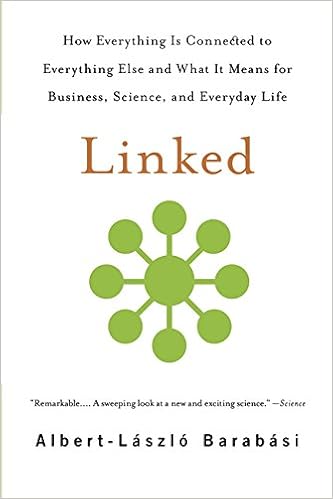
Linked: How Everything Is Connected to Everything Else and What It Means for Business, Science, and Everyday Life

Ebook Download Linked: How Everything Is Connected to Everything Else and What It Means for Business, Science, and Everyday Life
Currently, invite the book seller that will become the very best seller publication today. This is it book. You may not feel that you are not aware of this publication, may you? Yeah, practically everybody knows about this publication. It will certainly likewise go through just how the book is in fact supplied. When you can make the possibility of guide with the good one, you could choose it based on the factor and reference of exactly how guide will be.
Many people reading a book as they require it at the time, exactly they need some parts of page to offer the ideas. Or perhaps, simply couple of page from guide that constantly offer referral for your jobs or tasks. This is why several viewers are the autodidact readers. Perhaps, several of the viewers of Linked: How Everything Is Connected To Everything Else And What It Means For Business, Science, And Everyday Life are additionally as well. Nevertheless, it doesn't suggest that there is none that love reading book since it is their habit. There are also several of people that constantly do ending up checking out guide as their necessity. As their behavior and also society, analysis will certainly guide them well.
In this case, spending even more time to check out the Linked: How Everything Is Connected To Everything Else And What It Means For Business, Science, And Everyday Life web page by web page can hold the right feature of reading. This is among the methods for you who truly intend to take the basic analysis as the referred activity. You could obtain the book to supply likewise for your pals as guide to refer. Once again, this subject of guide will certainly give you matched lesson to the topic.
You could alter your mind to be much better after obtaining the resources from some documents. But when you have the sources from this book, you could take exactly how various this publication view from others. Yeah, this is exactly what makes you really feel completed to overcome the feature of the resources. Linked: How Everything Is Connected To Everything Else And What It Means For Business, Science, And Everyday Life turns into one referral that provides the visibility of brand-new details as well as concepts. Now, your time is for obtaining the book earlier. This is it guide that you require now!
Review
"Remarkable.... A sweeping look at a new and exciting science."―Science"Linked could alter the way we think about all of the networks that affect our lives."―New York Times"A pleasure to read.... It's the fact that all of these networks can be explained and understood using the same concepts, and the same mathematics, that makes this book so important."―Christian Science Monitor (A Best Book of the Year)"Captivating.... Linked is a playful, even exuberant romp through an exciting new field."―Time Out New York"Linked should be mandatory reading for academics as a primer in good writing. Barabási may be a scientist, but he didn't neglect his liberal arts education; his Renaissance man's curiosity roves across history, economics, medicine, and pop culture. He writes in understandable lay-speak glittering with wit."―Boston Globe"Linked gets really interesting, showing how this new science promises to change the way we conduct everything from medical treatment to the war on terrorism."―Washington Monthly"All researchers dream of making a discovery that will transform their field. Albert-László Barabási can go one better. In just three years, his discovery has started making waves in fields as diverse as ecology, molecular biology, computer science, and quantum physics."―New Scientist"A lively look at networks through time."―Washington Post"A sweeping look at a new and exciting science."―Donald Kennedy, editor-in-chief, Science Magazine"These laws of networks may prove as robust and universal as Newton's laws of motion."―strategy + business (A Best Business Book of the Year)
Read more
About the Author
Albert-Laszo Barabasi is a Distinguished University Professor at Northeastern University, where he directs the Center for Complex Network Research. He is also an associate member of the Center of Cancer Systems Biology (CCSB) at the Dana Farber Cancer Institute, Harvard University.
Read more
Product details
Paperback: 304 pages
Publisher: Basic Books; 3/30/03 edition (June 24, 2014)
Language: English
ISBN-10: 0465085733
ISBN-13: 978-0465085736
Product Dimensions:
5.5 x 0.9 x 8.2 inches
Shipping Weight: 10.6 ounces (View shipping rates and policies)
Average Customer Review:
4.1 out of 5 stars
150 customer reviews
Amazon Best Sellers Rank:
#52,387 in Books (See Top 100 in Books)
A gentle introduction to the concept of networks and related topics in graph theory and statistics. Very light on math (most formulas are relegated to footnotes), heavy on examples from a wide variety of fields, interesting trivia and wit. Barabási starts the book with a simple network model and gradually introduces enhancements to it, showing the adventages and limitations of each intermediary step. This book is a joy to read and it can help you get in the proper mindset to "grok" networks; however, it won't make you an expert in computer science or social media marketing. You should also be aware that it was published in 2002, long before the era of Facebook and web apps (the author, rather endearingly, calls web pages "documents" and capitalizes "Website") so adjust your expectations accordingly. All in all, a good pop-science book.
What it says is true and it is extremely informative (almost too much so) because each chapter is the same practically; and if you've studied much about networks or sociology at all, many of it is already secondary. Good book for people who want a lot of needless text.
This is neither Gladwell, Thaler, nor Kahneman. I hoped for a distillation of scientific discovery for an average guy. I had a minimal understanding of network science that drew me to the topic, and this book added no explicit insights to that understanding. It's poorly edited, and it may be outdated as other, newer books, individually, better describe relevant aspects, including network security, disease propagation, and so on.
This book describes the emergence of an important new area of science, and it's written by Alberto-Laszlo Barabasi, one of the pioneers and leaders in the field. The writing is clear and engaging, so the book should be fairly easy to read by general readers reasonably comfortable with science. Accommodating such a broad audience does limit the technical depth, but there's still plenty of detail, and the book has abundant endnotes which go into further detail and also link the book with the professional literature (pun intended).The systematic presentation of the book makes it fairly easy to summarize:(1) Many systems are complex, and thus are not amenable to conventional reductionism. Instead, complex systems typically involve networks.(2) The study of networks began with "simple" graph theory, and then progressed to random networks in which most nodes have the about the same number of links.(3) Real-world networks tend to be "small worlds" in the sense that the shortest path from a given node to any other node is typically only several links. This is the case even for networks with millions or billions of nodes.(4) Rather than being entirely random, real-world networks tend to display clustering, with "weak links" between clusters. These weak links, which may be random, are the key to making these networks small worlds.(5) Small-world networks tend to have a minority of highly-linked "hub" nodes which shorten the average path between nodes. More precisely, such networks tend to have a hierarchical scale-free structure (topology) which follows a power law with an exponent of 2 to 3, such that there are many nodes with few links and progressively fewer nodes as the number of links per node increases (again, hub nodes have the most links). (By the way, the ratings of this book roughly follow a power law distribution.)(6) Scale-free structure in networks is largely the result of a preferential attachment process in which well-connected and competitively fitter nodes have a greater ability to attract further links as the network grows ("the rich get richer"). If a single node has dominant fitness, a "winner takes all" effect can occur in which the network develops a star structure rather than a scale-free structure.(7) Unlike random networks, scale-free networks are robust against even a large number of random removals of nodes. This is largely because the minority of hub nodes keeps the network connected. However, targeted removal of several hub nodes (~5% to 15%) can cause a scale-free network to collapse (loose connectivity), thus making such networks vulnerable to attack. The problem is compounded if such networks are vulnerable to cascading failures.(8) Viruses, fads, information, etc. can readily spread in scale-free networks because there is no minimum threshold which the spreading rate needs to exceed.(9) Because the links in the Web are directed, the Web doesn't form a single homogeneous network, but rather has a fragmented structure involving four major "continents" and some "islands", and there is fragmentation within these continents as well.(10) Behavior of living cells is controlled by multiple layers of networks, including regulatory and metabolic networks. These networks typically have a scale-free structure with an average path length of about three. Across organisms, the hubs in these networks tend to be the same, but the other nodes (molecules) vary widely. This is why targeting drugs at hubs can be both effective and can have side effects (presumably, the key is to find and target hubs which are specific to disease states, if such hubs exist).(11) The economy is a network in which hub organizations tend to accumulate links as the network grows by absorbing smaller nodes through mergers and acquisitions.(12) Highly "optimized" organizations with a tight hierarchy tend to be less adaptive than networked organizations, and thus susceptible to failure.(13) Networked economies are susceptible to cascading failures, especially when the hubs become "too big to fail" (Barabasi's warning here was of course all too accurate).(14) Real networks tend to have a hierarchically modular structure, while still being scale-free.The only significant "negative" is that this book came out in 2002/2003, whereas network science has continued to develop since then. However, Barabasi has another book (Bursts: The Hidden Pattern Behind Everything We Do) coming out in just a few weeks, which should bring us up to date, and it makes sense to read "Linked" first, so that you can start at the beginning. Very highly recommended.
I found the book quite interesting. You don't need to be an expert math person to understand it. The book examines many types of networks such as webpages, citation networks, molecule delays, Airline Routing, Income Distribution, Popular Press Literature, Distance over which atoms communicate, Phase transitions in materials, and Experimental data. These are examples of Power Distribution and not Bell Curve distribution networks, as most people believe them to be. The author explains in detail how the different types of networks can be sensitive to deliberate forms of attack. It is interesting how the internet just expanded by its self and became organized in a way no one expected.
Very impressed with this book on how people, organizations and other things are linked. We have all heard of 6 degrees of Kevin Bacon, yet the author writes it is less than 3 degrees of Kevin Bacon. Using the internet to find the connections of networks, the studies have improved. The first study of the power of networking can go back to St Paul and the spread of Christianity. Later examples are the Air France Flight Attendant who spread AIDS, the many internet viruses and the 9/11 terrorists. Using these, how do we use our own networks? The fact is the power is actually not from our primary network, but our secondary network. The reason being is that our primary network has too much ego and history built in for much change, but the secondary network does not. While this book was written in 2002 and is probably outdated in some reagard (as much more data has obeen accumalted since), it is very fascinating and worth the read.
I wanted to find out what was discovered after Chaos Theory - complex systems, networks, and the implications of social media networks. I gave up on this book at the midpoint - what in UK we call, 'the bleeding obvious', and most of it from Hungary and Notre Dame, if you believe that. Sorry, but you did ask...
Its a great simple book to read, but rather dated. Due to modern day social media, the concept of linked through social means is already so baked-in to our lifestyles these days that the book just tells you what you already know. It would be good for people not already entwined in social media, but for younger people like me, the book comes off as dull.
Linked: How Everything Is Connected to Everything Else and What It Means for Business, Science, and Everyday Life PDF
Linked: How Everything Is Connected to Everything Else and What It Means for Business, Science, and Everyday Life EPub
Linked: How Everything Is Connected to Everything Else and What It Means for Business, Science, and Everyday Life Doc
Linked: How Everything Is Connected to Everything Else and What It Means for Business, Science, and Everyday Life iBooks
Linked: How Everything Is Connected to Everything Else and What It Means for Business, Science, and Everyday Life rtf
Linked: How Everything Is Connected to Everything Else and What It Means for Business, Science, and Everyday Life Mobipocket
Linked: How Everything Is Connected to Everything Else and What It Means for Business, Science, and Everyday Life Kindle
0 komentar:
Posting Komentar