Ebook Free A Troublesome Inheritance: Genes, Race and Human History
There is absolutely nothing to doubt t get this book as one of the knowing procedure to enhance the understanding as well as perception. When you can appreciate of the author and also guide, you might feel relieved to review guide. As a book, A Troublesome Inheritance: Genes, Race And Human History doesn't just come to be the reading product. It can be the friend to be always there with you. When you have absolutely nothing to do, this publication can be a wonderful alternate to make your time better.
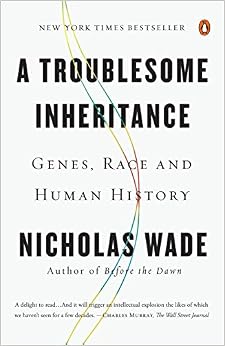
A Troublesome Inheritance: Genes, Race and Human History

Ebook Free A Troublesome Inheritance: Genes, Race and Human History
What sort of enjoyment book that you will take for accompanying your vacation time in your vacation? Is that the fiction book or novel or literary book or the accurate publication? Everyone has various taste to set as the enjoyable or amusement book for reading some could assume that the one that could amuse is guide that supplies the fun thing as well as its fiction. But, some additionally find that they will certainly love the valid publication as amusement to satisfy the free time.
If you among the viewers who are always checking out to complete numerous books and also compete to others, transform your mind established start from now. Checking out is not type of that competition. The method of exactly how you obtain exactly what you receive from guide one day will certainly confirm regarding just what you have actually got from reading. For you that do not like reading quite, why don't you attempt to apply with the A Troublesome Inheritance: Genes, Race And Human History This presented publication is just what will make you alter your mind.
Those are a few of the benefits to take when getting this A Troublesome Inheritance: Genes, Race And Human History by on the internet. Yet, how is the means to obtain the soft documents? It's quite ideal for you to visit this web page considering that you could get the link web page to download and install the publication A Troublesome Inheritance: Genes, Race And Human History Merely click the link supplied in this post as well as goes downloading. It will certainly not take much time to obtain this e-book A Troublesome Inheritance: Genes, Race And Human History, like when you require to choose publication shop.
When you have actually chosen that this is also your much-loved book, you should inspect and also get A Troublesome Inheritance: Genes, Race And Human History quicker. Be the firstly people and also accompany them to delight in the information related about. To get even more referral, we will reveal you the link to get and download and install guide. Also A Troublesome Inheritance: Genes, Race And Human History that we serve in this web site is type of soft documents publication; it does not indicate that the material will be decreased. It's still to be the one that will influence you.
Review
“[A Troublesome Inheritance] is a delight to read—conversational and lucid. And it will trigger an intellectual explosion the likes of which we haven't seen for a few decades.” --Charles Murray, Wall Street Journal: “Extremely well-researched, thoughtfully written and objectively argued…. The real lesson of the book should not be lost on us: A scientific topic cannot be declared off limits or whitewashed because its findings can be socially or politically incendiary…. Ultimately Wade’s argument is about the transparency of knowledge.” --Ashutosh Jogalekar, Scientific American “Nicholas Wade combines the virtues of truth without fear and the celebration of genetic diversity as a strength of humanity, thereby creating a forum appropriate to the twenty-first century.” --Edward O. Wilson, University Research Professor Emeritus, Harvard University “A freethinking and well-considered examination of the evidence “that human evolution is recent, copious, and regional.” --Kirkus Reviews “Wade ventures into territory eschewed by most writers: the evolutionary basis for racial differences across human populations. He argues persuasively that such differences exist… His conclusion is both straightforward and provocative…He makes the case that human evolution is ongoing and that genes can influence, but do not fully control, a variety of behaviors that underpin differing forms of social institutions. Wade’s work is certain to generate a great deal of attention.” --Publishers Weekly “Mr. Wade is a courageous man, as is anyone who dares raise his head above the intellectual parapet; he has put his argument with force, conviction, intelligence, and clarity.” --The New Criterion
Read more
About the Author
Nicholas Wade received a BA in natural sciences from King’s College, Cambridge. He was the deputy editor of Nature magazine in London and then became that journal’s Washington correspondent. He joined Science magazine in Washington as a reporter and later moved to The New York Times, where he has been an editorial writer, concentrating on issues of defense, space, science, medicine, technology, genetics, molecular biology, the environment, and public policy, a science reporter, and a science editor.
Read more
See all Editorial Reviews
Product details
Paperback: 288 pages
Publisher: Penguin Books; Reprint edition (April 28, 2015)
Language: English
ISBN-10: 0143127160
ISBN-13: 978-1594206238
Product Dimensions:
5.5 x 0.8 x 8.4 inches
Shipping Weight: 1.8 pounds (View shipping rates and policies)
Average Customer Review:
4.0 out of 5 stars
363 customer reviews
Amazon Best Sellers Rank:
#194,362 in Books (See Top 100 in Books)
Wow! After reading and scores of reviews here at Amazon and elsewhere, I feel more inclined to review the reviews than I do the book. However I will start with the book but won't spend a great deal of time on it.I take it that Nicholas Wade is attempting to make the case (1), that there are distinguishable races, and nations wherein some individual races predominate; (2), that it is plain that some nations have become more 'successful' than others; (3), that though genetic makeup in all is fairly straightforward in content, the presence or positioning of variant forms of those genes (alleles) cause differences in how they perform in the humans they occupy; (4), that said alleles are passed along hereditarily within races and nations, and possibly have the capacity to thrust those races evolutionally and advantageously forward in the human contest to achieve success; (5), that this process can be described as 'higher' societal cultures alongside higher IQs sending certain nations or societies into the forefront of international performance.Because the above smacks of racism, politically-correct-oriented academics must oppose Prof. Wade's hypothesis. But Prof. Wade argues that academia should set such fears aside in the interest of the furtherance of science's progress towards truth.My reviewing of the negative reviews of tells to me that Prof. Wade's views as publicized in his book, will continue to face strong opposition from the PC academia currently ensconced in U.S. institutions of higher learning; this, though Wade's line of reasoning is just as sound if not more so, than those of the 1960s-affected academics. All of this can be described as a continuing standoff between PC and certain opposing ideas that transcend PC.
The negative reviews of this book actually encouraged me to buy and to read through it. Afterwards I perused the reviews here on Amazon, and my conclusion is that the controversy regarding this book is another episode in the ongoing reaction to new insights developed from recent advances in genetics,from supporters of established social science, linguistic, and historical paradigms. For example, I recall viewing on YouTube last year a presentation called "The Assault on Historical Linguistics" that criticized competing paradigms generated by discoveries in genetics and by the resulting haplogroup mapping of human expansion across the world. I have seen other examples of defensive reactions by proponents of paradigms social science and historical paradigms that were established with the evidence available by the 1970s, this had led to strong attacks trying to discredit new conceptual frameworks driven by new discoveries in genetics.Nicholas Wade in his book states that racism must be opposed on principle, and that politics should not drive science. Perhaps the members of the current academic establishment need to retire so that a newer generation can look a new evidence with new and less prejudiced eyes.
Nicely researched, and eloquently presented. Anyone interested in the science of race will find a very fair breakdown of the issue in history, science and social application.If you are looking for justification for a racial superiority of any kind, this is not the book. In fact, the less racist you think you are, the more I would recommend this book, as a gateway to expanding your own horizons on the actual background of the subjects.I read this book in parallel with Steven A. LeBlanc's book Constant Battles: Why We Fight/The Myth of the Noble Savage and a Peaceful Past, and found them very mutually complementary.
5 stars for Nicholas Wade taking on a too-often politicized topic and presenting the science with unemotional seriousness.Many topics he covers may be new to readers, and disturbing, such as research done on racial variation in the MAO-A ("violence" or "warrior") gene and its association with psychopathic personality traits; world-wide variations in IQ and links to economic disparities and crime. All very interesting, none of which I'll detail here for fear of down-voting and inciting a comment war. The chapter "Jewish Adaptations" was eye opening, as well.Copious Notes helped me understand the depth of Wade's research into the important topic. A plus was that I found some new books to read, too.In Wade's hands, history and science are made plain, and you can't ask for much more. A studious reader will take much away from this book.I loved it/It was amazing5/5 Goodreads5/5 Amazon
Genetics, the study of heredity, once consisted of nothing but competing politically motivated opinions especially on issues of race, institutions, culture, and society. And it has been perverted by politicians, e.g., Stalin'/Lysenko's wacky genetics, Nazi's eugenics, and just as climate science now is being perverted by politicians for more power and control over people.. But since the discovery of the DNA helix in the 1950s, the automation of sequencing in the 1980s, and the reading of the entire human genome in 2003, the study of genetics has matured to a real science based upon molecular biology and the rigorous testing and verification or refutation of hypotheses. It promises to benefit all of mankind in many ways including improved medical treatment. And it also is revealing new insights into variations among different races. But American academia today is so intellectually corrupt that genetics researchers avoid the biology of race in favor of the politically accepted ideology of race for fear of being labeled racist and having their careers destroyed. But truth can't be suppressed everywhere not even by these neo Nazis.
A Troublesome Inheritance: Genes, Race and Human History PDF
A Troublesome Inheritance: Genes, Race and Human History EPub
A Troublesome Inheritance: Genes, Race and Human History Doc
A Troublesome Inheritance: Genes, Race and Human History iBooks
A Troublesome Inheritance: Genes, Race and Human History rtf
A Troublesome Inheritance: Genes, Race and Human History Mobipocket
A Troublesome Inheritance: Genes, Race and Human History Kindle
0 komentar:
Posting Komentar